
SIFARI
Self-Supervised Interferometric Fitting for Astronomical Radio Imaging
Status: Manuscript in preparation.
Public talk slides — Cosmic Horizons Conference 2026
Overview
SIFARI is a self-supervised neural workflow for radio-interferometric imaging. It fits the measured complex visibilities directly, without an external image training set or a hand-tuned image prior. The method represents the sky brightness distribution as a continuous function and adapts the available spatial detail to the signal supported by the visibility data. It also produces spatially resolved uncertainty and signal-to-noise diagnostics.
Training animation
Animation: SIFARI performs direct visibility fitting with a neural network. It represents the sky brightness distribution as a continuous function, transforms the predicted image into the Fourier domain, and compares it directly with the observed visibilities. The network is optimized iteratively to reduce the mismatch between model and data.
Selected results
Synthetic two-point-source benchmark
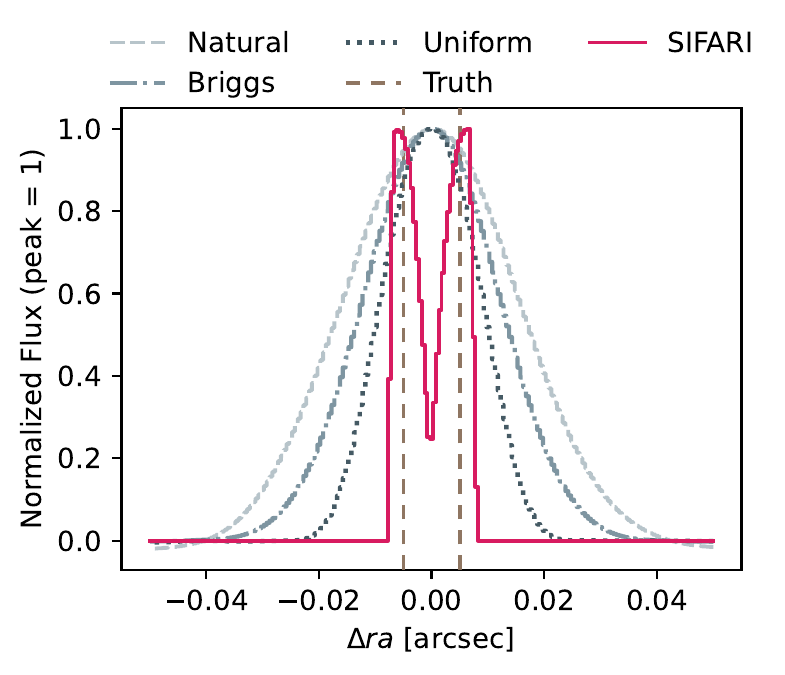
In this synthetic test, SIFARI reconstructs two distinct peaks at the injected 0.010-arcsecond separation. The Natural, Briggs, and Uniform CLEAN reconstructions (the gray-blue curves) instead form a single broad peak and fail to resolve the two point sources.
Synthetic HD 163296-inspired multi-ring benchmark
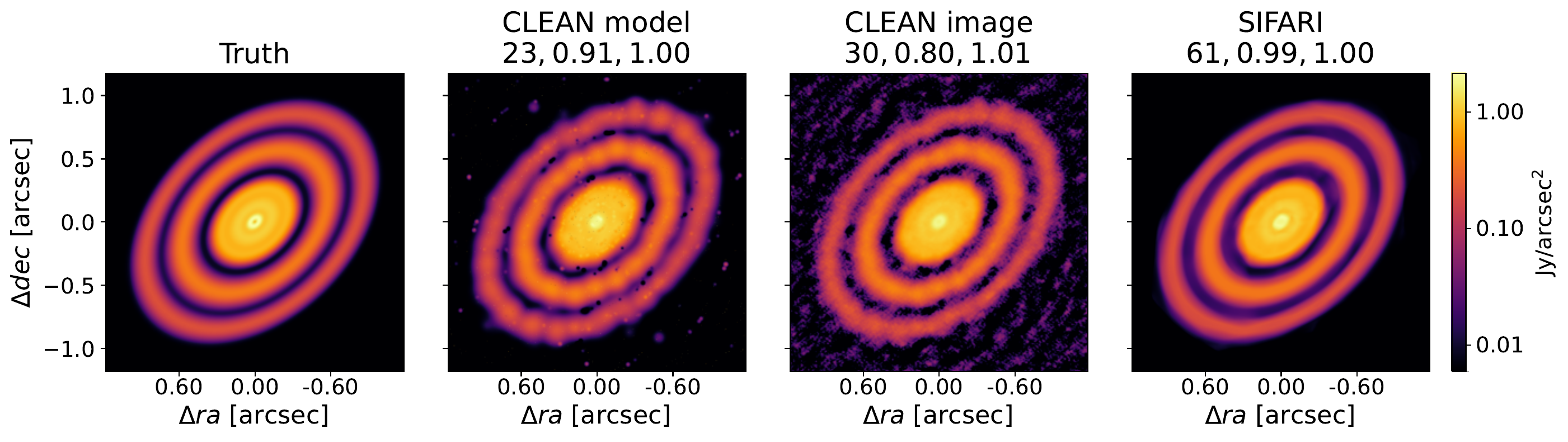
This synthetic benchmark compares the ground truth with a CLEAN model, a restored CLEAN image, and the SIFARI reconstruction. The panel headers report image fidelity (IFS), structural similarity (SSIM), and recovered flux ratio; higher IFS and SSIM indicate closer agreement with the ground truth.
ALMA observations of PDS 70
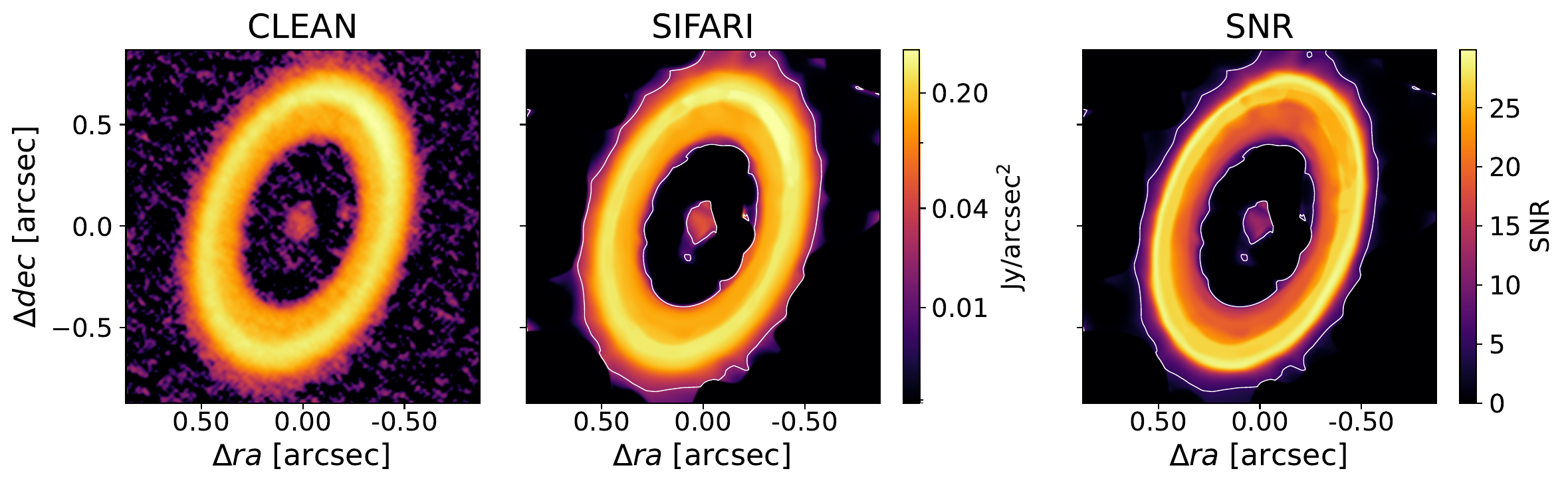
Global view of the PDS 70 continuum emission. The panels show CLEAN, SIFARI, and the spatially resolved SIFARI signal-to-noise diagnostic; white contours mark the 5-sigma uncertainty contour.
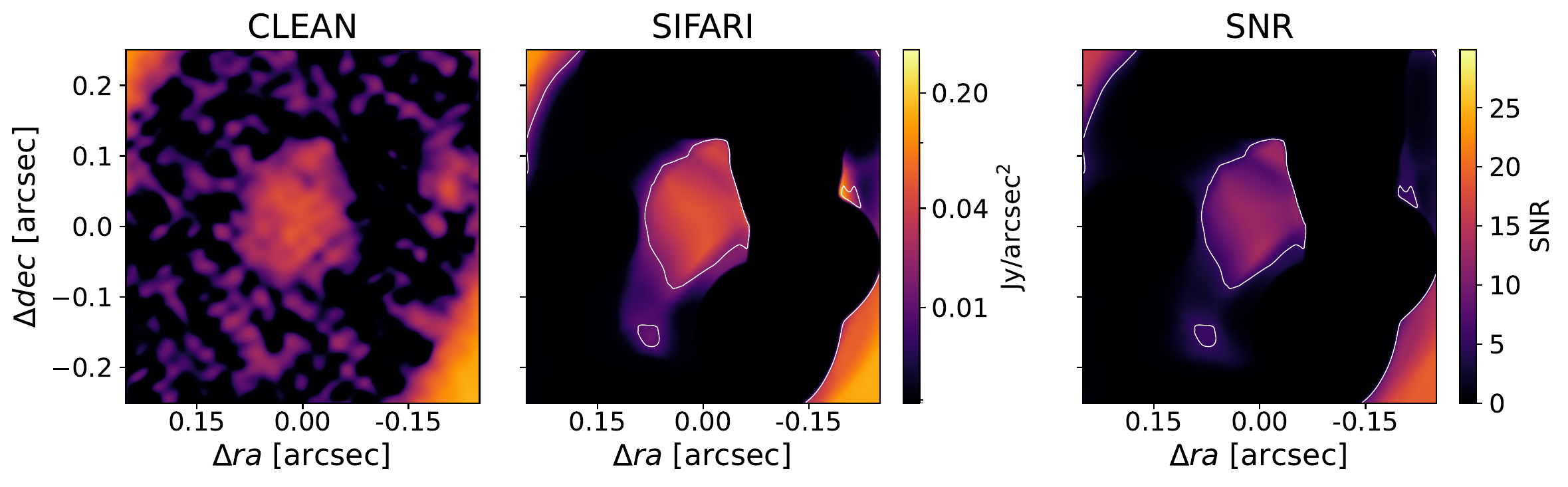
Zoomed view of the central region, including the candidate locations of PDS 70 b and PDS 70 c.
Collaborators
This work is being developed with Andrea Isella (Rice University), Paris Perdikaris (University of Pennsylvania), Li-Ta Lo (Los Alamos National Laboratory), and Hui Li (Los Alamos National Laboratory).